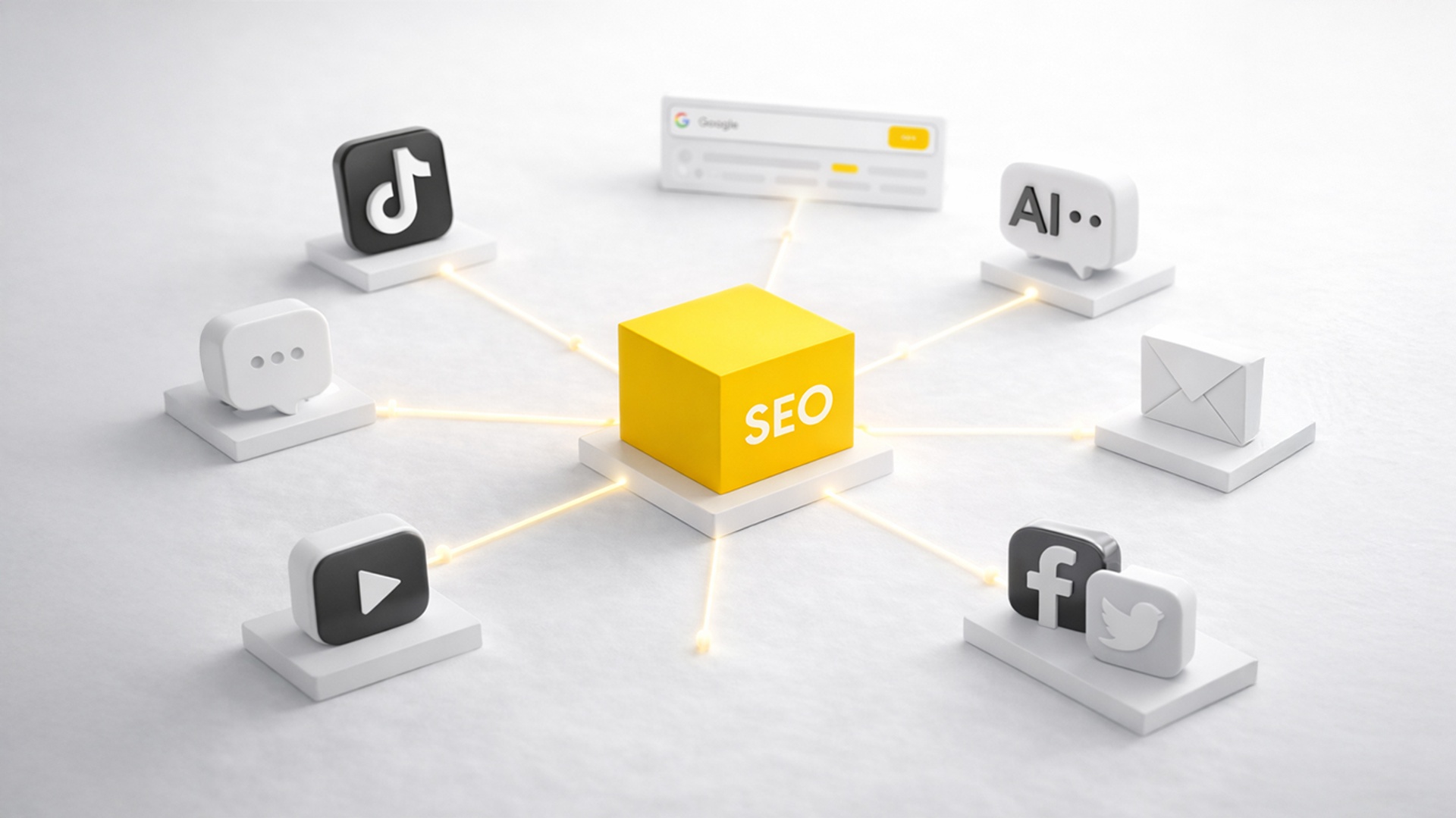
SEO in 2026: Why It's No Longer Just About Google
How SEO is transforming from technical search engine optimization into a discovery strategy across every platform - from social media to AI interfaces.
SEO in 2026 can no longer be reduced to technical search engine optimization. It's a mindset for visibility, a practical toolkit, and a strategic necessity for any business that wants to be found, recognized, and chosen. A decade ago the goal was simple: rank higher on Google. Today your audience's attention is scattered across platforms, formats, and interfaces.
Search Everywhere Optimization
This transformation demands a new way of thinking, best described as Search Everywhere Optimization. It's an expanded model of traditional SEO that treats search as a multi-layered, contextual, and behavioral process.
Content is no longer discovered only through text queries - it surfaces on video platforms, social networks, communities, visual search, and increasingly through AI interfaces. Users don't just type a keyword anymore. They ask questions, seek recommendations, compare alternatives, watch demos, check reviews, and expect a synthesized answer.
Key Insight: The way people search for information is shifting toward conversational, context-driven interactions. Classic SEO - keywords, meta tags, link building - still matters, but it's only the starting point.
AI Overviews and the End of Clicks
In recent years, Google has started embedding generative AI answers directly into the results page through what it calls AI Overviews. Instead of a list of links, users increasingly get a synthesized answer pulled from multiple sources. The feature has been rolling out globally since 2024 and already shows up in a significant share of searches.
When an AI summary appears in the results, far fewer users bother clicking on traditional links - driving up the share of so-called "zero-click" searches.
What This Means: Organic traffic no longer depends only on ranking position. What matters is whether your content can serve as a source for AI summaries and whether algorithms recognize it as a reliable, clear, and authoritative source.
The User Is Everywhere
The same person might hop between several platforms in a single day depending on what they need in the moment. Each of these touchpoints calls for a different content format and a different approach to optimization.
TikTok / Instagram
Quick visual answer
YouTube
In-depth analysis
Forums & communities
Real opinions
Pinterest / visual
Inspiration & style
AI chat interfaces
Synthesized answer
Social Media and Video Platforms
On social platforms, content has to grab attention in seconds and spark engagement. The algorithms run on behavioral signals - views, shares, reactions, and time spent interacting. Optimization here goes well beyond keywords; it's about storytelling, pacing, visual energy, and a compelling message.
On video platforms, users commit real time to learning something or solving a problem. What matters is narrative structure, clearly framed topics, and how ideas build on each other. Algorithms weigh not just the title and description, but also watch time, retention rate, reactions, and discussion activity.
The Rule: Visibility follows interest, and interest comes from relevance and emotional resonance. Optimization means creating content that doesn't just earn the click - it holds attention and delivers genuine value.
Communities and Visual Platforms
On community platforms, trust and authenticity are everything. Users come looking for real opinions and expert takes, not sales pitches. Hard-sell marketing falls flat here. Success means joining conversations, sharing well-reasoned answers, and proving you know what you're talking about.
Visual platforms run on association. Users aren't just searching for information - they're looking for a concept, a style, a mood. Content needs to be not only informative but also visually polished, thematically curated, and clearly tied to specific ideas.
Join the conversation
Share thoughtful, backed-up answers
Demonstrate real expertise
Create visually compelling content
AI Interfaces Are Changing the Paradigm
Search is becoming a conversation. Users ask a specific question and expect a clear, structured, synthesized answer. In this model, optimization means crafting content that can be interpreted, synthesized, and cited by algorithms.
Logical structure, clear definitions, well-crafted paragraphs, and topical flow become the deciding factors. It's no longer enough for a page to be indexed - it has to be understandable to both humans and machines.
New Concepts: Answer Engine Optimization and Generative Engine Optimization describe how to optimize for systems that don't just show links - they generate answers. Visibility hinges on whether your content can be read as a trusted source of knowledge.
SEO as a Discovery Strategy
In this context, SEO becomes an integrated discovery strategy. It spans audience analysis, understanding intent, mapping user journeys, and creating content that works across formats without losing consistency.
Your brand needs to be instantly recognizable whether someone encounters it in a short video, a long-form article, a community thread, or an AI-generated answer.
Audience Analysis
Understand what your users want and how they behave
User Journeys
Map where and how your audience searches for answers
Multi-format Content
Adapt the message for each platform and channel
Consistent Brand
Stay recognizable at every touchpoint
Putting It Into Practice
Start by identifying the key questions your audience is asking, then build content pillars that can be adapted for each platform. One in-depth analysis can spin off into multiple formats without losing its core message.
Measuring Beyond Traffic
Traffic is still an important metric, but it's far from the only one. Engagement, time on site, community mentions, and showing up in AI summaries are all part of a much fuller performance picture.
A winning strategy doesn't just count visits - it measures the quality of each interaction and its real impact on how users make decisions.
The New Standard: Success is no longer about ranking position alone. It's about how meaningfully your brand shows up across the entire digital landscape.
The Future Is Distributed
SEO in 2026 is about adapting to how modern users actually behave. It takes flexibility, analytical thinking, and the ability to work across formats. That doesn't mean abandoning the technical fundamentals - site speed, solid structure, clear content. But on that foundation you build a broader strategy, one that accounts for the fact that search is no longer centralized - it's distributed.
Search Everywhere Optimization isn't a buzzword - it's a reflection of reality. Search is distributed, behavior is contextual, and information gets consumed in wildly different formats. The business that understands this shift and creates content accordingly won't just be visible - it'll be sustainably discoverable and genuinely relevant.
If you want to build a strategy like this - not just for Google, but for the entire digital ecosystem - explore our SEO & Web Optimization, Social Media Management, or Content Creation services. You can also book a free consultation - one well-structured presence is worth more than ten separate tactics.
Vision. Impact.
From strategy and branding to social media, growth, and the final cut - everything aligned to build a powerful digital identity.
Ready to grow together?
Everything starts with a short, free consultation.